
Mental Contemplation - Between Representation and Reality
Reflections on Yossi Mark’s Exhibition “Good Night Mother” at the Tel Aviv Museum of Art
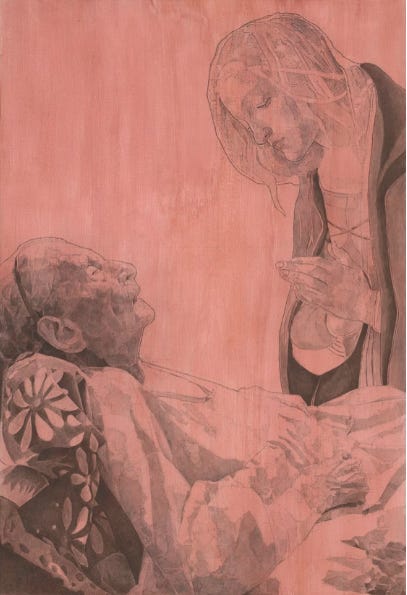
Yossi Mark’s exhibition, winner of the 2024 Chaim Shiff Prize for Figurative-Realist Art, offers viewers an moving and inspiring experience that invites reflection on the central themes characterizing Mark’s creative journey, which are also expressed in the work completed shortly before the exhibition’s opening: “Good Night Mother.”
Although much has been written about the uniqueness of the fusion between the analytical, constructive nature of direct observation of artistic subjects (particularly figures) and the intimate, enigmatic expression that draws part of its inspiration from the masterworks of the past, I will note several emphases from the course of the exhibition.
The first aspect is the combination of innate talent with the ability to actualize that talent through refinement of professional technical dimension—what is called in English “craftsmanship.”
In an era when the ability to give meaning to form in visual art has almost been lost, this is no small achievement, testifying to the artist’s commitment to a goal: the fusion of talent with a worldview that seeks spiritual meaning in artistic creation itself.
Beyond talent and ability, what is revealed here is an uncompromising dedication to the foundational principles of visual art as it existed in its heyday in the pre-modern civilization era.
Entering Mark’s main exhibition space creates a kind of cultural dissonance and even a certain shock, stemming from the sharp transition to a state of mental contemplation that draws its inspiration from the perception of artists who experienced the visual field through a virgin eye before the phenomenon of Simulacrum.
The person of our time will struggle to understand the essential difference between the sensation of being in the visual field in an era when there was no camera, television, internet, or YouTube, and continuous existence under an incessant barrage of images that has caused “lazy eye”—those mental changes resulting from consciousness being flooded in a way that causes the relationship between reality and its representation to weaken, until it is no longer capable of digesting what stands directly before it.
This is not the place to elaborate on the meaning of the preference for simulacra in contemporary art and the loss of meaning of form and image in reality itself (as described in French philosopher Jean Baudrillard’s book “Simulacra and Simulation”). However, in the context of Mark’s exhibition, it is worth noting that one of the conceptual achievements emanating from its content and language is the intuitive recognition that artists such as Masaccio, Mantegna, Caravaggio, and Piero della Francesca had a profound and reverent relationship with the world of images before they were replaced by content-diluted representations. Therefore, one must commend the curatorial decision to place some of Mark’s works in the hall with the old masters!
The second aspect is the choice of the human figure as a central motif—not incidental or random figures, but rather the closest people, family members. This choice allows the intimate familiarity with the figures to be elevated to the level of the archetypal-universal.
The sense of closeness evoked by the figures is a kind of self-portrait that permits observation devoid of pathos yet simultaneously full of empathy. In this context, I recall an exhibition of Rembrandt’s self-portraits at the Fogg Museum at Harvard in the late 1970s whose subject was a look at the self, in which it seemed as though Rembrandt’s self-portraits were painted as if from an objective observation by another artist.
One of the qualities of Mark’s self-portraits, as well as those of his family members, and especially that of the mother, is precisely the deep, focused, and meditative gaze into the inner self—one that creates a delicate balance between intimacy and objectivity, between closeness and criticality, a gaze that examines and investigates facial features and from there meets the soul itself. This is a contemplation that projects spiritual focus that knows the “I” of the painted figure.
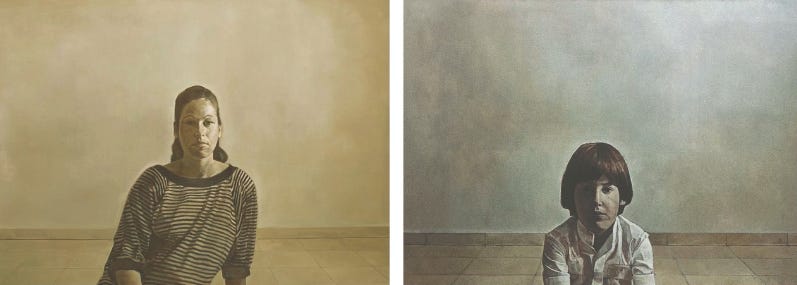
In the endless parade of the selfie phenomenon in our digital world that presents the self as simulacrum, it is most refreshing to experience the gaze of the figures in the present painting, centered in the composition and looking directly at us, creating with us, the viewers, a silent dialogue that radiates honesty, authenticity, and directness.
The third aspect worth emphasizing is based on the artist’s special dialogue with the figure of the mother in the final stages of her life. In the special work “Good Night Mother,” Mark directs his gaze toward death as a process of transition to a transcendent reality, hinted at through the figure of the praying woman elevated to the spiritual. This is essentially a kind of private Pietà of the artist, but instead of the classical symbolism presented in Michelangelo’s famous sculpture, where the young Mary holds her son just taken down from the cross, here the son-artist expresses deep compassion and acceptance toward the physical dissolution.
The implied symbolism transcends Christianity or any cultic religious aspect. It is a personal spiritual religiosity expressed in a gesture of parting filled with grace toward the artist’s beloved mother. This is a sensation of contemplation in a spiritual achievement devoid of pathos that elevates personal dialogue to a universal dimension.
Beyond aspects related to art itself, Yossi Mark’s exhibition “Good Night Mother” constitutes a relevant and unique statement in an era of loss and grief in Israel and indeed in the entire world, and thereby serves as a kind of spiritual refuge inviting every visitor to the exhibition moments of inner contemplation and peace of soul.
—Joseph Rapoport